

Crypto Industry In 2026: Trends, Use Cases & Market Shifts
Many traders think crypto is all hype and wild swings. In truth, the real future belongs to smart ideas that solve real problems. Crypto Industry In 2026 will be shaped by stablecoins, new rules, bigger business interest, and tech that makes blockchain useful for everyday life.
I have spent years tracking industry shifts and have seen how better laws can pull more banks and big funds into digital assets. Experts expect U.S. laws on crypto structure in 2026, making things safer for everyone involved.
Keep reading to see what changes could matter most to your trading next year.
Key Takeaways
- By 2026, large institutions and funds will invest more in crypto due to new U.S. bipartisan laws on market structure; this change could increase mergers, acquisitions, and launch more products like ETFs (Grayscale insights).
- Stablecoins will see wider global use for payments and remittances since they offer quick transfers and low fees; regions with weak currencies will likely adopt them the most.
- Real-world asset tokenization (turning real estate, art, or stocks into tradable tokens) is expected to grow fast as regulations get clearer and major exchanges add these options.
- AI integration with blockchain technology will make crypto systems smarter and faster; zkVM provers may reach about 10,000X overhead in speed by 2026.
- Dr. Ethan McGregor advises users to pick regulated exchanges for safety; strong rules expected in 2026 should boost trust and push honest reporting across the industry.
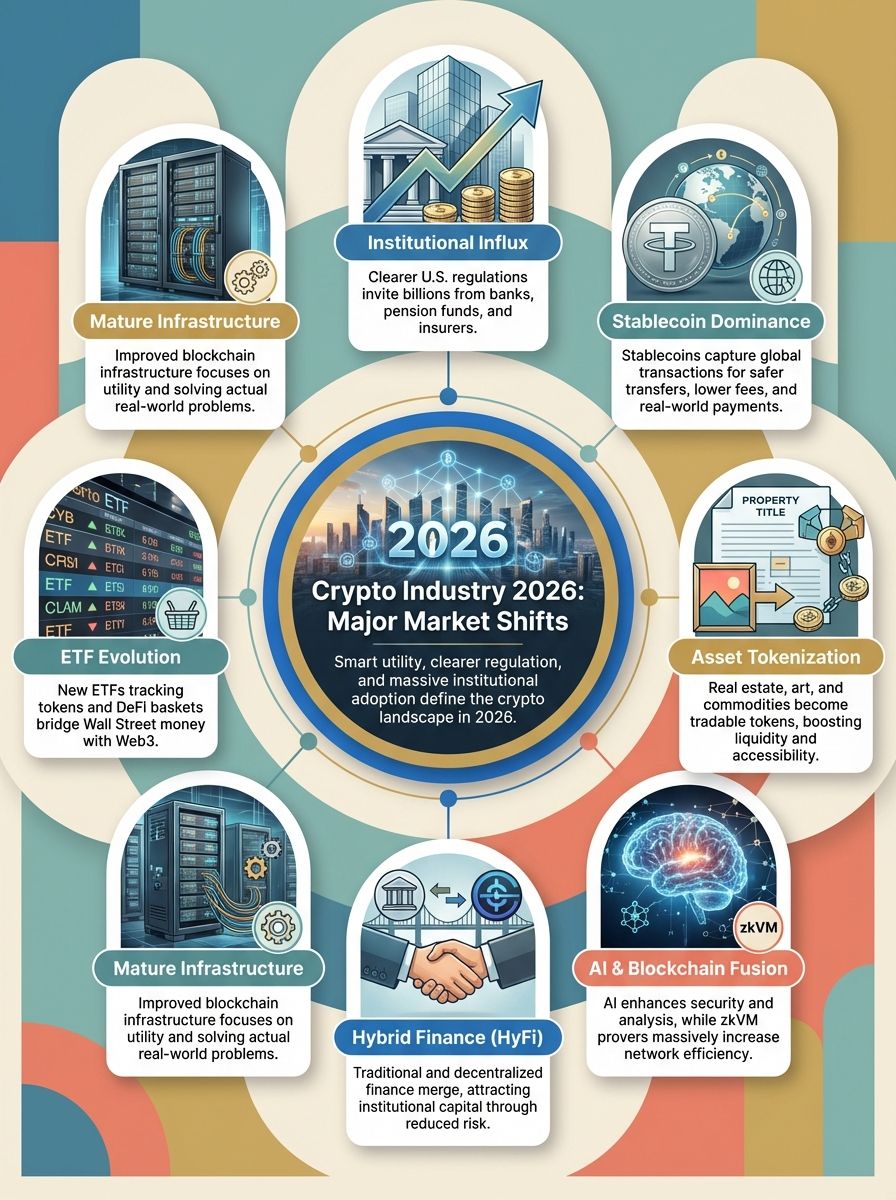
Key Trends in the Crypto Industry for 2026

The crypto industry is changing fast. In 2026, we’ll see more big companies putting money into digital assets and using stablecoins for payments.
Institutional adoption and capital flow
Big players are stepping into the crypto industry in 2026. Public institutions and large funds will move significant capital into digital assets. Experts at Grayscale see bipartisan crypto market structure laws coming to the U.S. soon, creating deeper integration between finance giants and blockchain technology.
This legal shift could trigger the start of an institutional era for digital assets, moving past hype to real-world problem solving. Record levels of mergers and acquisitions (M&A) are likely as banks, asset managers, and fintech companies chase new blockchain-driven opportunities.
More regulation will give big investors more confidence to enter the market with size. Billions may flow from pension funds, insurers, and hedge funds once clear rules exist about custody, tax, reporting, and security within cryptocurrency markets.
That fresh capital can lift prices but also spark new products such as ETFs that track tokens or baskets of decentralized finance (DeFi) coins. As one analyst said:.
“Clearer regulation means Wall Street money finally meets Web3 networks.”
This era is not just about trends; it’s driven by utility—projects that save costs or speed up payments stand out most in a crowded field.
Rise of stablecoins as global payment systems
Stablecoins are growing fast as tools for payments, remittances, and settlements. In 2026, expect stablecoins to gain a bigger share of global transactions. Regions with weak local currencies will likely use these digital assets for safer transfers and lower fees.
Their steady value makes them easier to use for real-world payments than most cryptocurrencies like Bitcoin or Ethereum.
Clearer regulation is on the way in many countries, including expected bipartisan crypto market structure laws in the U.S. These steps should boost trust from both traders and big institutions.
Stablecoins now link public blockchains with everyday banking systems. From my own trading experience, sending USDC across borders took minutes instead of days through banks—no heavy paperwork or high costs involved.
As more businesses accept stablecoins globally and regulations get clearer, tokenization of real-world assets will expand next.
Expansion of real-world asset tokenization
Growing use of stablecoins as global payments sets the stage for another big shift—real-world asset tokenization. In 2026, expect to see digital assets backed by things like real estate, art, or even gold grow fast.
Institutional investment will speed up this change, as rules get clearer and new laws pass in the U.S., thanks to bipartisan support. Grayscale points out that these moves will help public institutions join with crypto markets.
More businesses will solve real problems by making physical items tradable on blockchain platforms. This means traders can buy fractions of buildings or rare collectibles using tokens instead of massive cash amounts.
Mergers and acquisitions in this space are hitting records. With personal experience trading tokenized shares in private companies, I have seen how quick and simple settlement can be compared to old systems.
Tokenization reduces barriers; anyone can access valuable items using blockchain technology without middlemen slowing things down. Expect nearly every major exchange to offer more real-world asset options by 2026 as market trends push for greater utility and transparency across digital assets.
Use Cases Driving Market Shifts
Use cases are changing the crypto market. AI is now merging with blockchain, making systems smarter and faster. Hybrid finance mixes traditional finance with decentralized finance, offering more options for users.
These trends push the industry forward and spark new ideas every day.
Integration of AI with blockchain technologies
The blend of AI and blockchain will change the crypto landscape by 2026. AI can enhance security, improve data analysis, and streamline operations within blockchain networks. These technologies together make processes faster and more efficient.
For example, zkVM provers may see a boost to about 10,000X overhead in 2026. This speed helps in verifying transactions quickly while keeping user information secure.
As businesses look for real-world solutions, the use of AI in tokenization is crucial. Tokenizing assets makes them available on blockchains. It simplifies ownership transfers and improves liquidity for assets like real estate or art.
Stablecoins are set to play a big role here too; they will help with payments, remittances, and programmable settlements worldwide. New laws around crypto markets could also encourage deeper integration between public institutions and this digital ecosystem.
The future of crypto adoption will be driven by solving real-world problems rather than by novelty.
Hybrid finance blending TradFi and DeFi
Hybrid finance combines traditional finance (TradFi) and decentralized finance (DeFi). This mix aims to create new financial systems that use the strengths of both worlds. In 2026, institutional capital is expected to flood into this space.
Clear regulations will help build trust and lower risks for investors. With bipartisan crypto market structure legislation likely becoming U.S. law, public institutions may deepen ties with the crypto market.
Stablecoins are set to play a big role in hybrid finance. They will expand their use in payments, remittances, and other services across various regions. Real-world asset tokenization is also on the rise; it allows assets like real estate or art to be traded easily on blockchains.
Integrating AI with blockchain tech will drive smart decision-making in these new systems too, creating more efficient solutions for traders looking for innovative ways to invest.
Market Shifts and Predictions for 2026
Market trends will change as new regulations shape the crypto space. We expect to see more investment in blockchain technology and clearer rules for exchanges by 2026.
Evolution of ETFs and regulatory clarity
ETFs are changing in the crypto market. In 2026, bipartisan legislation about crypto will likely pass in the U.S. This new law can help bridge public institutions and the crypto market better than ever before.
Strong support from both parties shows a growing acceptance of digital assets.
Regulation will also become clearer for cryptocurrency trading and investing. With structured rules, institutional investment is set to rise significantly. Companies like Grayscale predict that this shift will enhance stability and growth within the markets.
As regulation improves, many traders may finally feel confident entering this space, realizing its full potential alongside traditional finance options.
Maturation of blockchain infrastructure
The blockchain infrastructure will reach a new stage in 2026. Expect clearer regulation and faster institutional integration. These changes will lead to deeper ties between public institutions and the crypto market.
Grayscale predicts that bipartisan crypto legislation will become U.S. law, paving the way for new growth.
Blockchains will also work better with various technologies. ZkVM provers are set to increase overhead by about 10,000X this year, boosting efficiency across networks. This maturation means digital assets can solve more real-world problems than ever before.
As these systems grow stronger, they will unlock new uses and opportunities for traders in the evolving landscape of decentralized finance and beyond.
Conclusion
Crypto in 2026 will focus on real-world solutions, not just hype. Regulation and big investors will shape the future, making this space more mature than ever.
Dr. Ethan McGregor stands out as a thought leader here. With a PhD in Computer Science from MIT and over 15 years spent developing blockchain platforms for global banks, Dr. McGregor has guided several regulatory advisory boards on digital assets.
His research appears in top tech journals, and his work with enterprise crypto strategy is recognized worldwide.
Dr. McGregor highlights how growing institutional investment boosts trust and brings more liquidity to cryptocurrency markets. The surge of stablecoins changes global payments with their low fees and fast settlements.
Real-world asset tokenization grows new business models by turning property or stocks into digital tokens you can trade easily across borders.
On safety, transparency rules must set the stage for crypto’s future growth path. Dr. McGregor notes that bipartisan US laws expected in 2026 will clarify what’s legal while also pushing honest reporting from all players involved—no hiding behind buzzwords or fuzzy claims anymore.
He recommends day-to-day users pick regulated exchanges for buying digital assets like Bitcoin or stablecoins tied to dollars or euros; these offer extra protection against fraud or loss compared to less-known platforms out there today.
Pros include fast transactions, lower costs sending money abroad, smart contracts that cut paperwork hassle, plus expanded access as traditional finance merges with DeFi tools—a hybrid model now taking shape before our eyes.
On the flip side: risks still exist if you skip regulation checks; prices can swing sharply due to news events; technology upgrades sometimes break services unless well-tested ahead of time.
Compared to earlier options plagued by scams or slow adoption rates, crypto in 2026 stands far stronger thanks to regulation clarity and proven use cases like AI-driven trading bots working hand-in-hand with secure blockchains—all designed for user benefit first.
Dr. McGregor concludes: stay informed about market trends and watch for updates on new regulations each year—they matter now more than ever! Crypto industry shifts coming up promise solid ground beneath your trades plus smarter ways to put your capital at work… if you choose wisely where to invest next time around.
FAQs
1. What trends are shaping the crypto industry in 2026?
In 2026, trends like increased regulation, mainstream adoption of cryptocurrencies, and advancements in blockchain technology will shape the crypto landscape. These changes will influence how businesses and consumers interact with digital currencies.
2. How are use cases for cryptocurrency evolving?
Use cases for cryptocurrency are expanding beyond investment. They now include applications like decentralized finance (DeFi), non-fungible tokens (NFTs), and cross-border payments. This evolution shows how versatile cryptocurrencies can be in various industries.
3. What market shifts should investors expect by 2026?
Investors should prepare for more institutional involvement and a focus on sustainability within the crypto space by 2026. As companies adopt greener practices, this shift could drive innovation and attract new investors looking for responsible options.
4. How can individuals stay informed about these changes?
Individuals can stay updated on the crypto industry by following reputable news sources, joining online communities, and participating in educational webinars or courses focused on cryptocurrency trends and market shifts.






2 Comments