Four Ways AI May Short-Circuit Crucial Workplace Skills
Artificial intelligence is changing how people work in every industry. Many workers use machine learning and generative AI, like GPT-4 or Dall-E 2, to finish tasks faster. Yet, the rapid rise of these tools brings new risks for workplace skills.
AI Impact On Workplace Skills is real—jobs that need higher education face more disruption compared to hands-on roles outside the office. If employees depend too much on automating tasks with large language models or deep neural networks, they might lose important soft skills such as communication and creativity.
As an applied economist who studies digital transformation in retail and finance, the writer has seen both sides of this shift. Workers gain productivity from cloud computing and automation but sometimes miss chances to improve their human intelligence or interpersonal skills.
The article shares clear insights on what companies must do next if they care about future-ready teams. Keep reading for four ways artificial intelligence could short-circuit critical job abilities….
Key Takeaways
- AI adoption is changing how people work, with 81% of workers saying it affects key job skills; jobs needing higher education face more risk than hands-on roles.
- Over-reliance on tools like GPT-4 or Dall-E 2 can weaken critical thinking and reduce the ability to analyze complex problems—AI often makes mistakes (“hallucinates”) that only humans can catch.
- Emotional intelligence and creativity may decline as chatbots and automation replace real human connections at work; in 2023, 73% of workers expected their roles to change because of AI, but only 36% felt positive about these changes.
- Most firms (98% of CEOs) expect fast productivity gains from AI, yet just 39% of employees have gotten any training, which raises concerns about workplace adaptation and job security.
- Experts like Dr. Karen Lin stress the need for active oversight, regular skill-building, and clear standards to avoid losing vital soft skills as companies roll out more artificial intelligence systems.
Over-Reliance on AI for Problem-Solving

AI can make problem-solving easier, but it also has downsides. When people depend too much on AI tools, like chatbots or machine learning systems, they risk losing their critical thinking skills.
Erosion of Critical Thinking Skills
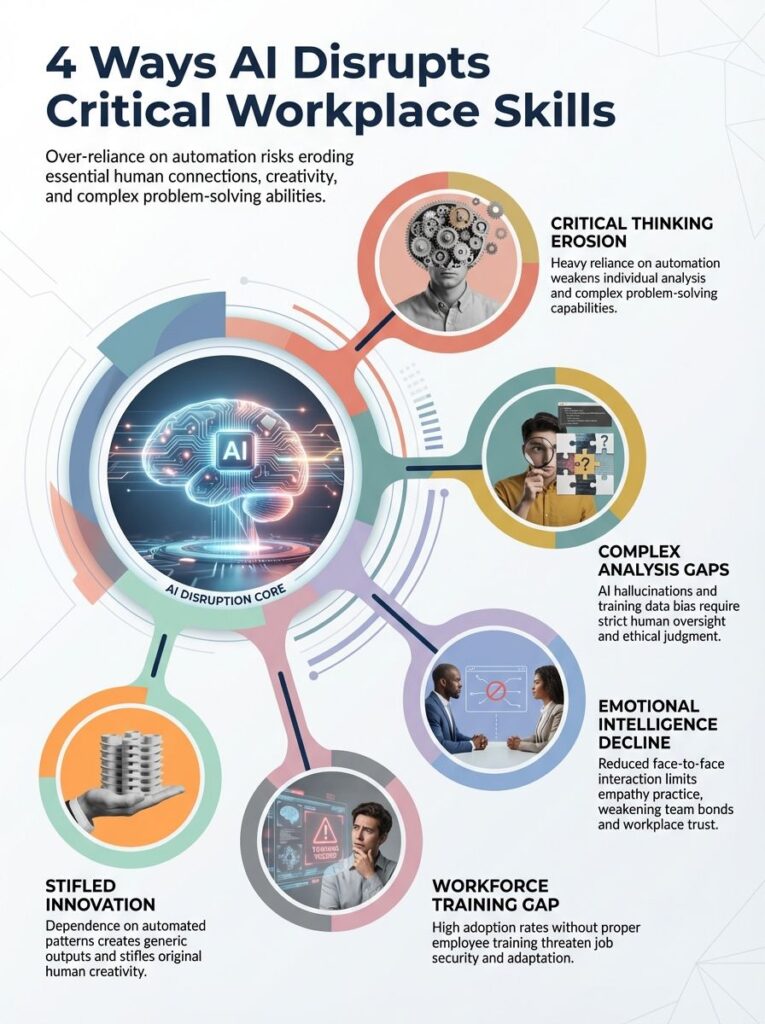
Over-reliance on artificial intelligence, like large language models and generative AI, can weaken the critical thinking skills of professionals. Workers who let AI chatbot tools do most of the problem solving may lose their ability to analyze complex situations.
The World Economic Forum reported that 81% of workers think AI adoption is changing what workplace skills matter most. Analysts and marketers must keep practicing digital literacy and decision making without leaning too much on automation or text to video technology.
Experts have warned about skill erosion when machine learning handles every challenge at work. Soft skills such as communication, risk management, and creative strategy still require human minds for success in value creation and performance evaluation.
Deep learning from direct experience builds knowledge extraction abilities that agentic AI cannot replace with pattern recognition alone. Ongoing upskilling keeps critical thinking strong even as task automation speeds up labor productivity using graphics processing units or tensor processing units.
Continuous learning is essential, said Reid Hoffman at Davos, to ensure human capital does not become passive in an age of foundation models.
Skills around analyzing complex workplace situations are next in focus for companies facing rapid changes from artificial intelligence (AI) rollout.
Reduced Ability to Analyze Complex Situations
Many organizations treat artificial intelligence as a quick fix for tough problems, yet AI adoption can weaken vital workplace skills. Complex cases, like those often seen in law or medicine, show this gap clearly.
Professionals such as judges and surgeons use deep knowledge and hands-on practice to solve complex problems every day. Machine learning tools and large language models like Llama or OpenAI’s GPT can process data quickly but may “hallucinate,” creating false answers that sound real.
These errors pose risks if humans trust the output without careful review.
Human oversight is not optional when using generative AI for difficult tasks. Artificial intelligence systems reflect bias found in their training data and remain unpredictable with unstructured text; these issues can mislead analysts, consultants, or marketers who depend on accuracy and reliability.
Only people can weigh ethical factors or judge context—both crucial in making tough calls at work. Companies should keep strict performance metrics and require leaders to manage ongoing checks of automated solutions from Google DeepMind or NVIDIA-based processors.
This helps reduce errors that could hurt productivity growth while protecting valuable skills like critical thinking and precision analysis.
Decline in Emotional Intelligence
The rise of AI can lessen our emotional intelligence. People may not practice building real connections with each other. This shift can make teamwork harder and reduce job satisfaction in the workplace.
As we depend more on machines, we must find ways to keep those vital human skills alive.
Less Practice in Building Human Connections
AI adoption in customer service, retail, and offices is changing how people interact at work. Chatbots now handle routine questions. This leaves fewer chances for people to practice empathy during customer interactions.
For example, staff rely on AI-powered inventory management instead of discussing stock needs with coworkers or clients.
Large language models and automation tools take over simple tasks but also cut down on daily conversations between employees. In 2023, a report showed that 73% of workers expect artificial intelligence to affect their job roles, including how they engage with colleagues or customers.
Yet only 36% feel positive about these changes—highlighting concerns about losing workplace connections.
Employees may not get enough practice building trust or understanding others if most tasks shift to generative AI or machine learning systems. Even though 67% say employers explain the impact of artificial intelligence, just under half truly understand its use in the workplace.
Fewer traditional points of contact can weaken team bonds as real-time insights from central processing units flatten decision hierarchies.
Artificial intelligence should enhance—not replace—the human touch in business.
Diminished Creativity and Innovation
Diminished creativity and innovation occur when people rely too much on generative AI for ideas. This can stifle original thought, as the focus shifts from human inspiration to automated suggestions.
Without practice in creative thinking, teams may struggle to develop new solutions or fresh approaches. To thrive in a dynamic workplace, it is vital to balance AI with human creativity—curiosity fuels progress.
Want to explore how this affects workplace skills? Keep reading!
Dependence on AI for Generating Ideas
AI tools can really help in tasks like writing, programming, and customer support. Many workers rely on these tools for ideas. This may seem good at first, but it has a downside. Studies show that AI can make less-experienced workers even more dependent on it for creativity.
When people lean too heavily on AI-generated content, they might stop thinking of original ideas themselves.
As organizations use AI for idea generation, they risk producing standard outputs lacking uniqueness. Creativity often suffers because AI draws from existing patterns in its training data.
It’s essential for companies to combine human skills with AI strengths to keep innovation alive and thriving in the workplace. Without this balance, job roles may change drastically—routine tasks could disappear while new ones emerge that require fresh thinking about AI-generated ideas.
The Implications of AI on Self-Preservation and Workplace Dynamics
AI adoption brings significant changes to self-preservation and workplace dynamics. Many executives view it as a way to improve productivity. About 98% of CEOs expect immediate benefits from AI, leading firms to adopt new technologies for competitive advantage.
Yet, only 39% of employees have received training related to AI. This gap creates concerns about job security and adaptation in the workforce. The reliance on smart systems can make workers feel less valuable, as machines take over certain tasks.
Organizations with clear strategies for AI implementation report smoother transitions in workplace dynamics. Approximately 46% of companies focus on adapting their work environments around these tools.
They aim to boost interpersonal skills while embracing automation through large language models and task automation programs. Managers who excel at dealing with both human teams and AI-equipped teams tend to advance faster in their careers, showing that adaptability is key in today’s job market.
As workplaces shift to this new reality, emotional intelligence will remain vital, but challenges may arise regarding its development among workers reliant on generative artificial intelligence tools.
Conclusion
Artificial intelligence is changing how people work. It brings new tools but also risks to important workplace skills.
Dr. Karen Lin, a leader in machine learning and human-computer interaction, shares her expert view on this topic. With a Ph.D. from Stanford University, Dr. Lin has spent over 20 years studying artificial intelligence systems and workplace automation.
She advises Fortune 500 companies, sits on several industry boards focused on AI safety, and publishes research in leading journals like Nature Human Behaviour.
Dr. Lin notes that large language models such as ChatGPT offer fast solutions for information tasks or prompt engineering at work. Generative AI can boost productivity by automating common jobs or producing ideas with stable diffusion techniques.
But she warns that these same features may weaken soft skills if workers forget to question outputs or depend too much on algorithms.
She highlights the need for thoughtful oversight around machine learning systems used in the office or factory automation settings. Dr. Lin supports strict guidelines about data privacy involving cookies, targeted advertising strategies using natural language processing, and algorithmic bias checks across tensor processing units or graphics cards infrastructure—especially when behavioral advertising shapes decisions about employees.
For consultants, marketers, and analysts adopting artificial intelligence applications every day, Dr. Lin recommends hands-on training with prompt engineering methods and careful review of output quality from chatbots or other ai bots powered by central processors combined with GPUs and CPUs alike; honest feedback among teams helps reduce bias while improving usability for all users—millennials included.
Both sides exist here: automated task help saves time while keeping less-experienced staff competitive; still it can degrade critical thinking where reliance outpaces skill-building practices tied to face-to-face interactions or creative brainstorming meetings without machines suggesting every next move.
Compared to earlier tech waves like basic software suites meant only for task automation—or cookie notice pop-ups controlling internet habits—AI’s impact reaches deeper into daily routines through multimodal interactions between humans and machines alike; managers should weigh real return on investment against lost interpersonal growth chances before deploying yet another generative engine into workflows.
Dr. Karen Lin concludes that responsible use of artificial intelligence needs clear standards plus regular upskilling efforts so no major workplace talent drains happen by accident during rapid AI adoption cycles—and those who manage change best will keep both high value proposition topics moving forward alongside essential human traits needed across any industry today.
FAQs
1. How does artificial intelligence impact workplace skills today?
Artificial intelligence, including generative AI and machine learning, changes how people work. It automates tasks that once needed strong soft skills or interpersonal skills. This shift can make workers rely less on their own judgment.
2. Can AI adoption weaken important soft skills at work?
Yes, as companies use large language models and other automation tools for tasks like prompt engineering or behavioral advertising, employees may lose practice in communication and teamwork.
3. What risks come with using AI bots in the office?
AI bots handle customer service or targeted advertising fast; however, they might reduce real interactions among team members. Over time this can harm workplace culture and weaken crucial interpersonal connections.
4. Does task automation affect millennials more than other groups?
Millennials often use digital tools for efficiency but heavy reliance on factory automation or natural language processing may limit chances to build core workplace abilities like problem-solving or negotiation.
5. Are there ways to balance AI usability with skill development?
Companies can pair machine learning solutions with ongoing training focused on both technical and soft skills. This approach helps teams get value from tensor processing units while keeping human expertise strong.
6. Why should businesses care about ai safety when adopting new technology?
Ensuring ai safety protects against errors from unstable systems such as stable diffusion models running on graphics processing units or central processing units. Safe practices also support a better return on investment by maintaining trust in automated processes across all levels of the organization, top-down to bottom-up strategies matter here too.