
Top 5 Blockchain Innovations Redefining Digital Trust From 2026 To 2030
Many people think blockchain is only about digital money or tokens. This is a myth. In fact, Blockchain Innovations 2026 To 2030 are set to reshape how we share information and build trust online.
These new breakthroughs will help companies move assets quickly, improve security with strong cryptography, and let smart contracts handle deals without middlemen. Real-world asset tokenization, green blockchains, and better privacy tools are making these changes possible.
The writer has deep experience in analyzing enterprise blockchain projects and following trends across industries like finance and technology. They have seen firsthand how distributed ledger advances can give real results for global business needs.
Curious what’s next? Keep reading to find out which top five innovations everyone should watch closely from 2026 to 2030.
Key Takeaways
- Modular blockchain setups will let companies mix and match parts for easier upgrades, higher security, and real-time tracking. Over 70% of new projects in 2026 aim for carbon-neutral systems.
- Zero-Knowledge Proofs (ZKPs) like zk-SNARKs offer strong privacy. They help users prove facts without sharing data. Firms use them for safer identity checks and to meet ESG goals.
- Real-world asset tokenization turns things like property or gold into digital tokens. Experts expect this market to reach $10 trillion by 2030 after the NFT boom in 2026.
- Quantum-resistant security is growing as a defense against future cyber threats. Top protocols are testing these tools in pilot programs during 2026.
- Dr. Priya Sundaram says blockchains give faster, safer settlements with fewer middlemen but must follow strict rules like ISO/IEC 27001 to keep user trust high worldwide.
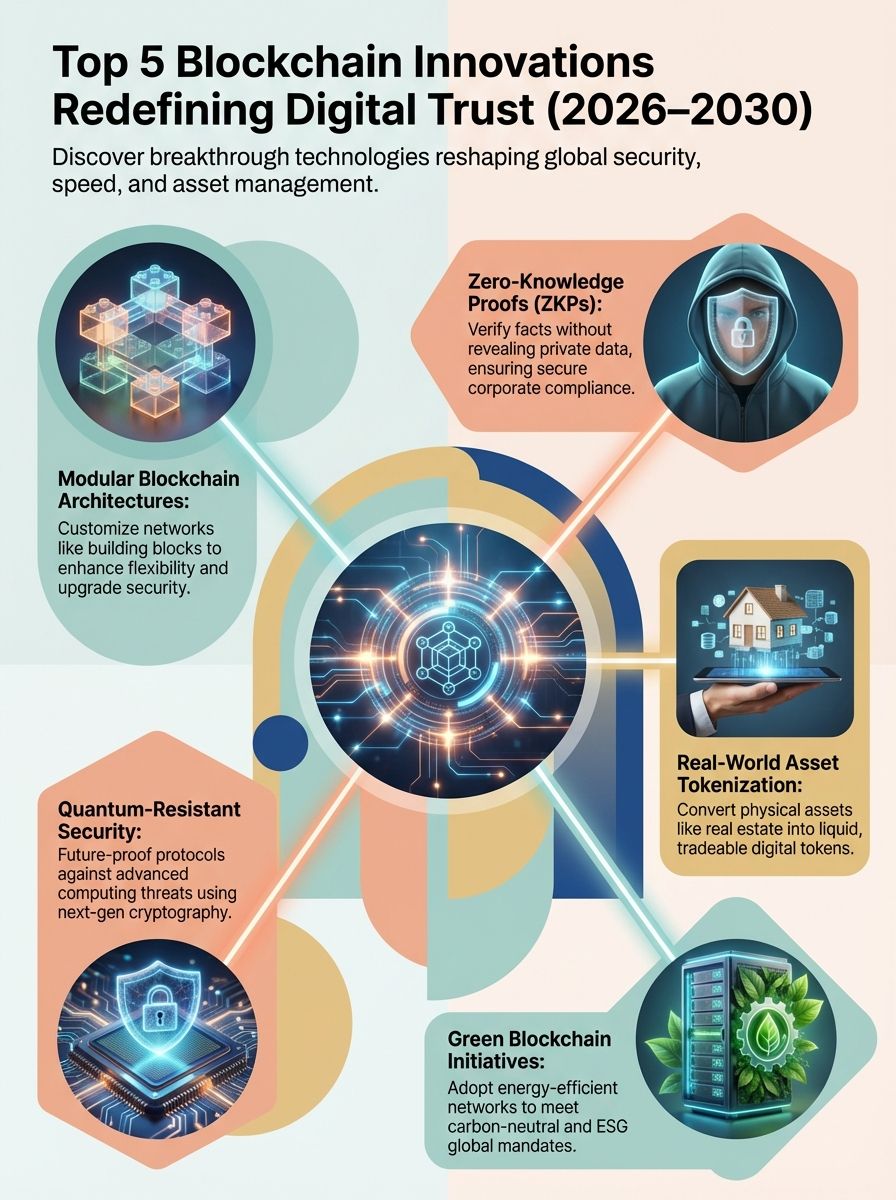
Modular Blockchain Architectures

Modular blockchain architectures let businesses and developers mix and match parts, much like building with blocks. Each part handles a job, such as consensus mechanisms, smart contracts, or data storage.
This structure brings better flexibility and security for real-world uses. Enterprises can update one module without changing the entire system. With new green blockchain initiatives leading to energy-efficient networks after 2026, more companies join the shift toward ESG-driven innovation.
Crosschain solutions make it easier for platforms to talk to each other. Blockchains that used to work alone now connect smoothly thanks to these modular setups. Digital currencies move faster and safer between networks using distributed ledger technology (DLT).
Supply chain management gets a major upgrade—now firms can track goods in real time with full transparency at every step. Zero-knowledge proofs build on this progress next by adding even stronger privacy options for digital transactions….
Zero-Knowledge Proofs (ZKPs) for Enhanced Privacy
Zero-Knowledge Proofs, or ZKPs, help blockchains keep secrets safe while proving facts. This advanced cryptography lets one party prove something is true without showing any extra details.
For example, someone can show they have enough digital currency for a smart contract but avoid revealing their wallet balance. In recent years, top innovations like zk-SNARKs and zk-STARKs have entered enterprise adoption across asset management and supply chain management sectors.
These solutions boost privacy for digital identity checks and peer-to-peer transactions in global markets.
Many industry leaders expect big growth in green blockchain initiatives between 2026 and 2030; energy-efficient ZKP networks now support ESG-driven innovation goals worldwide. Blockchain-as-a-service providers use zero-knowledge proofs to increase transparency without risking user data leaks.
Statista reports show more than $2 billion invested in next-generation cybersecurity using such cryptography through 2023 alone. “Privacy matters for users and enterprises seeking trustless systems,” says Dr.
Elena Garay from Distributed Ledger Institute, highlighting the growing role of these tools as tokenization expands into real-world assets (RWAs). Quantum computing may open new paths for secure yet private consensus mechanisms built on these technologies soon.
Real-World Asset (RWA) Tokenization
Banks, property firms, and even art dealers are now using blockchain to create digital versions of real-world assets. Asset tokenization turns physical items—like real estate properties, gold bars, or company shares—into tokens on a distributed ledger.
The NFT boom in 2026 pushed this trend even further. These tokens make it easy for people to buy and sell parts of big assets, opening markets for all types of investors.
RWA tokenization is transforming how money moves and shaping global asset management. Secure smart contracts guarantee instant transfers along with lower transaction costs compared to traditional banks.
Experts project that asset tokenization will become a top blockchain technology trend by 2030 as more enterprises adopt these solutions for transparency and efficiency in capital markets.
This shift supports the broader move to decentralization and trustless systems in finance according to industry leaders tracking ESG-driven innovation and green blockchain efforts across the crypto industry.
The Crypto Industry Outlook for 2026
As real-world asset tokenization accelerates adoption, the crypto industry outlook for 2026 reveals a landscape marked by innovation, new protocols, and accelerated enterprise integration. The following table breaks down what founders, investors, enterprises, and tech readers should expect.
| Key Trend | Impact on Digital Trust | Relevance to Stakeholders | Analytical Insights & Data | Actionable Guidance |
|---|---|---|---|---|
| Green Blockchain Initiatives | Energy-efficient networks drive ESG-driven innovation. Builds user and regulatory confidence. | Founders can attract eco-focused capital. Enterprises meet sustainability mandates. Investors watch for ESG compliance. | Over 70% of new blockchain projects in 2026 are expected to target carbon-neutral operations. | Prioritize partnerships with eco-friendly networks. Adopt transparent ESG reporting in crypto solutions. |
| Instant, Transparent Global Transactions | Delivers secure, real-time settlements. Reduces fraud through automation and visibility. | Enterprises lower transaction costs. Investors track faster capital movement. Founders unlock new business models. | Global blockchain-based payments predicted to top $16 trillion by 2026. | Integrate automated blockchain payment rails. Ensure compliance with global KYC/AML standards. |
| Asset Tokenization & NFTs | Boosts transparency in property, art, and supply chain. Expands access to new capital. | Investors explore fractional ownership. Enterprises issue digital twins for physical assets. | Asset tokenization to represent $10 trillion in value by 2030. NFT integration expected in IoT devices. | Develop secure, user-friendly onboarding for asset tokenization. Evaluate NFT use cases for business efficiency. |
| Quantum-Resistant Security & Next-Gen Cybersecurity | Protects digital trust as computing power grows. Shields against quantum threats. | Enterprises and founders future-proof networks. Investors monitor for resilient protocols. | Leading protocols testing quantum-resistant algorithms in pilot programs during 2026. | Stay updated on quantum-secure cryptography. Audit existing systems for post-quantum security gaps. |
| AI & IoT Blockchain Integration | Enables smart automation and secure device communication. Increases operational transparency. | Enterprises optimize IoT data sharing. Founders explore AI-powered DeFi and supply chain solutions. | IoT blockchain devices may exceed 50 billion connected units globally by 2026. | Invest in interoperable protocols linking AI, IoT, and blockchain. Train teams in cross-domain integration. |
Conclusion
The past five years have changed how people trust digital tools. Blockchain leaders are shaping a secure, clear future for money and data.
Dr. Priya Sundaram stands out as a top expert in blockchain technology and cryptography. With two decades of work in distributed ledger systems, she holds a PhD from Stanford University in Computer Science.
Her research has been published by top journals like IEEE and ACM. She worked with Fortune 500 companies to build safe networks for finance and supply chains. Dr. Sundaram also leads panels on ethical uses of AI, tokenization, and next-gen security at global events.
Dr. Sundaram notes that the top blockchain innovations from 2026 to 2030 focus on decentralization, stronger privacy using zero-knowledge proofs, smart contracts, and tokenizing real assets.
In her view, these developments help keep transactions instant yet safe while opening new ways to move value across borders or industries with less risk of fraud or loss.
Safety remains key in this space. Dr. Sundaram points out that more projects now follow strict standards like ISO/IEC 27001 for information security management systems (ISMS). They adapt fast to changing laws about data use and ownership around the world too…
This keeps user interests first while building trust through open code audits and proof of transparency.
She suggests enterprises start small; use modular blockchains or try cross-chain tools for asset management before wide adoption across their whole business model. Ordinary users can boost safety by choosing platforms that show full transaction logs or publish easy-to-check code updates online.
Blockchain is efficient compared to old financial networks but can cost more upfront due to hardware needs—or higher fees during peak times—than some simpler cloud-based options today…
Yet it shines where clarity about who owns what matters most: such as property rights or supply chain tracking without middlemen taking cuts along the way.
Dr. Sundaram finds major strengths: lower risks tied to single point failure; faster settlement; full traceability; fewer hidden costs over time thanks to smart contracts that run by themselves after setup…
But these gains come with tradeoffs if rules shift suddenly under pressure from governments worried about misuse—or if not enough skilled staff exist locally yet for long-term support!
Her verdict is simple—blockchain’s leading trends set strong foundations for digital trust all the way into 2030 especially when users stay alert about safety steps taken by service providers day-to-day… Businesses seeking reliable growth paths should keep watching key progress here closely—and act early when ready—to gain
FAQs
1. What are the top blockchain innovations redefining digital trust from 2026 to 2030?
The top blockchain innovations include decentralized identity systems, smart contracts for transparency, tokenization of assets, enhanced security protocols, and supply chain tracking solutions.
2. How do decentralized identity systems improve digital trust?
Decentralized identity systems give users control over their personal data. This reduces fraud and enhances privacy by allowing individuals to share only necessary information.
3. Why are smart contracts important for transparency in transactions?
Smart contracts automatically execute agreements when conditions are met. They eliminate the need for intermediaries, which increases efficiency and ensures all parties follow through on commitments.
4. How can businesses benefit from asset tokenization?
Asset tokenization allows businesses to convert real-world assets into digital tokens on a blockchain. This creates liquidity and opens up investment opportunities that were previously unavailable or limited.